Happy Monday!
I want to talk about something that comes up in almost every discovery call I have, and it usually sounds like this:
"I've applied to so many jobs. I know I'm qualified. I just don't understand why nobody's calling me back."
Here's the hard truth I have to share: being qualified and looking qualified to a machine are two completely different things in 2026.
Today I'm pulling back the curtain on how the ATS (Applicant Tracking System) actually works, what recruiters do in the 7-10 seconds they spend on your resume after that, and how to write a resume that clears both hurdles.
Let's get into it.
What an ATS actually does (it's not what most people think)
Most people imagine the ATS as a simple keyword search. It's not. Modern ATS platforms are ranking engines. When your resume enters the system, it gets parsed, scored, and sorted, often before a single recruiter logs in.

Here's what the system is actually doing when your resume lands:
-
Parsing your content into categories: contact info, work history, education, skills. If your formatting is too complex (tables, columns, graphics, text boxes), the parser scrambles your content and you look like a mess.
-
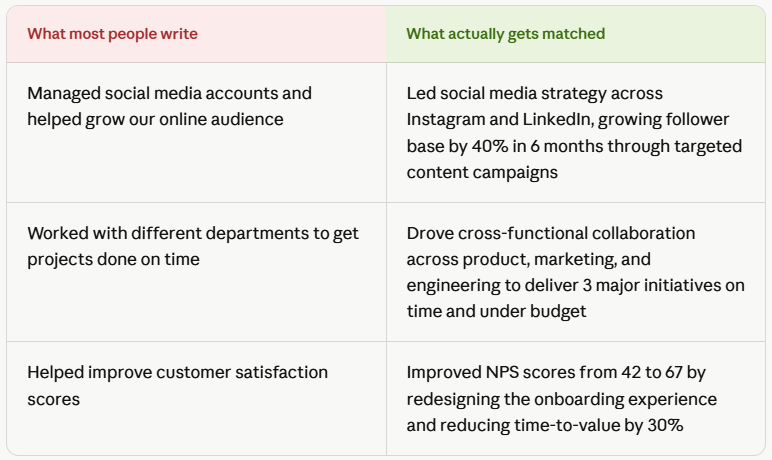
Matching your language to the job description. Not concepts, not intent, exact language. If the job says "cross-functional collaboration" and your resume says "worked with multiple teams," the system may not connect those dots.
-
Scoring and ranking you against every other applicant. Recruiters often open a ranked list. If you're not in the top 20, you may never get seen.
This is why someone with 10 years of perfect experience can get zero callbacks, while someone less experienced gets three interviews in a week. It's not about who's more qualified. It's about whose resume speaks the system's language.
The language match problem (and how to fix it)
The single biggest reason qualified people get filtered out? Their language doesn't match the job description.
ATS systems do exact and near-exact matching. That means you need to mirror the specific words and phrases the employer used, not your own version of them.
Here's how to do it:
-
Copy the job description into a document and highlight every repeated skill, tool, or phrase.
-
If you have that experience, use their exact wording. Don't paraphrase.
-
Weave those keywords naturally into your bullets and skills section, not in a keyword dump at the bottom.
The 7-second scan: what a recruiter is actually looking for
Let's say your resume clears the ATS. Now it lands in front of a human, and they're looking at 100+ resumes that day.
They are not reading. They are scanning. In those 7-10 seconds they're asking one question:
Can I immediately tell what this person can come do for us, based on what they've already done?
If the answer isn't obvious in the first half of the first page, they've already moved on.
Here's what recruiters are scanning for:
-
Your most recent role and company (is this relevant?)
-
Your summary or headline (does this match what I'm hiring for?)
-
Numbers (do I see any proof of impact?)
-
Clean structure (can I find what I need fast?)
This is why a bloated, two-page resume packed with every job you've ever had is working against you. More is not better. Clarity is better.
The bullet point problem: tasks vs. results
This is where most resumes fall completely flat. People list what they were responsible for, not what they actually achieved. To a recruiter, a list of responsibilities tells them what your job description said. It tells them nothing about you.
Use this formula for every bullet point:
Action verb + Specific task + Quantified result + Business impact
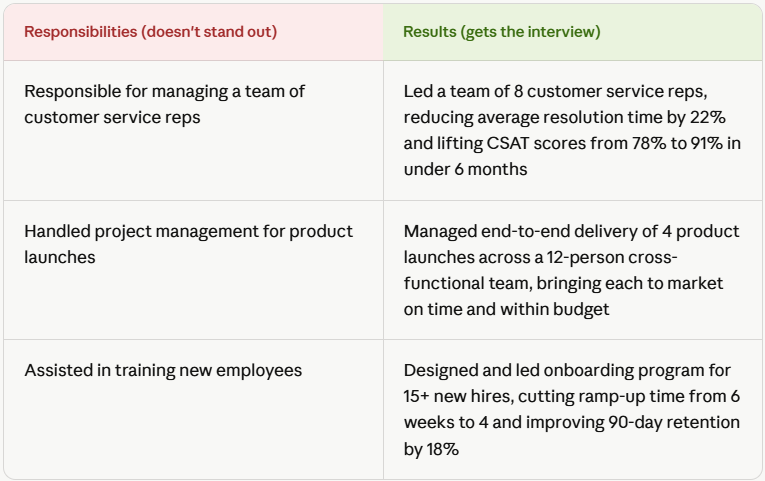
Don't have exact numbers? Estimate. A range is fine. Saying "reduced ramp time by approximately 25%" is infinitely stronger than saying nothing at all.
How to optimize each section of your resume
Header & contact info
-
Keep it clean. Name, city/state (not full address), phone, professional email, and your LinkedIn URL. No headshots. No graphics. No fancy borders. These break the parser.
Professional summary (3-4 lines max)
-
This is your 10-second pitch written directly to the role. Include your title, years of experience, 2-3 core strengths, and one line about the value you bring. Mirror language from the job description here. This is prime real estate — don't waste it with "results-driven professional seeking a challenging opportunity."
Core competencies / skills
-
A clean, scannable list of 10-15 relevant skills. This is keyword gold for the ATS. Use exact phrasing from the job description. Group by category if helpful (technical skills, leadership, industry tools). Keep it to one line per category — this is not the place for paragraphs.
Work experience
-
List in reverse chronological order. Each role gets 3-5 bullets maximum. Lead with your strongest bullet. Every bullet should answer: what did you do, how well did you do it, and what did it mean for the business? Aim for 60% of your bullets to include a number, metric, or measurable outcome.
Education
-
Degree, institution, graduation year. That's it. Unless you're a recent grad, this section should be brief and at the bottom. Certifications relevant to the role can live here too or in a separate section — just make them easy to find.
The Bottom Line
The resume that gets the interview answers one question before they can even ask it
Before you hit submit on your next application, read your resume and ask yourself honestly:
If a recruiter read this, could they immediately answer: what can this person come do for us, based on what they've already done?
If the answer is anything other than a clear yes, you've got work to do.
Your resume is not a career diary. It's a marketing document. And the job of a marketing document is to get you in the room, not to tell your entire story.
Be specific. Be results-focused. Speak their language. Keep it clean.
The ones getting interviews aren't always the most qualified. They're the ones whose resumes made it easiest to say yes.
Want your resume to pass the ATS and stop recruiters mid-scroll? That's exactly what we work on inside coaching.
If you've been applying and hearing nothing back, let's change that.
If you are ready to get to work, here are two ways we can work together.
As always, hit reply and tell me: what's the part of your resume you've always felt unsure about? I read every single response.
Talk soon,
💛 Alyssa
P.S. The resume that helped my client go from 0 interviews to 5 in two weeks wasn't longer than everyone else's. It was clearer. Specific. Results-focused. That's the version we're going to build for you.




Responses