You know your experience. You've done impressive work. But when someone asks you to talk about it in an interview... suddenly you're three minutes into an answer and you can see the interviewer's eyes glazing over.
Sound familiar?
Most people don't ramble because they don't know their stuff. They ramble because they don't have a structure to hang their story on.
And without structure, even the best career moments fall flat.
I've been thinking a lot about storytelling lately—specifically, what makes some stories land while others lose people halfway through. And it turns out, great storytelling follows a predictable pattern. Hollywood screenwriters use it. Entrepreneurs use it. And job seekers can use it too.
The 7 Elements of a Story That Lands
Every compelling story—whether it's a movie, a sales pitch, or an interview answer—has the same basic ingredients. Here's how they translate for your career:
1. A Character Who Wants Something (That's You) In the first few seconds of your answer, the interviewer needs to understand who you were in that moment and what you were trying to achieve. One clear goal. Not five things at once. Not something vague like "I wanted to do a good job." Something specific: I wanted to reduce our customer churn rate. I wanted to launch the product on time despite losing half the team.
2. With a Problem (The Hook) This is what makes people pay attention. What was the challenge? What was at stake? If there's no problem, there's no story. We were three weeks from launch and our main vendor pulled out. The team had never done this before and morale was tanking.
3. Meets a Guide (A Mentor, Framework, or Realization) In movies, this is the wise sage who helps the hero. In your story, it might be a mentor who gave you advice, a framework you applied, or a realization you had that shifted your approach. My manager reminded me that we'd navigated ambiguity before. I remembered a prioritization method from a previous role.
4. Who Gives Them a Plan (Your Strategy) This is where you show your thinking. What was your approach? How did you break down the problem? Keep it clear and simple—interviewers want to see that you can create a path forward, not that you stumbled into a solution. I mapped out the three biggest risks, assigned owners to each, and set up daily 15-minute syncs to stay ahead of blockers.
5. And Calls Them to Action (The Decision Point) Every good story has a moment where the hero has to commit. What decision did you make? What was on the line? I made the call to cut two features so we could hit the deadline. It wasn't popular, but it was the right trade-off.
6. That Results in Success (The Outcome) What happened? Be specific about the impact. Numbers help, but so does clarity about what changed. We launched on time. Customer feedback was strong. And the two features we cut? We shipped them eight weeks later with better specs.
7. Or Failure—and What You Learned Not every story ends in a win, and that's okay. Some of the most powerful interview answers are about things that didn't go perfectly—as long as you show what you took from it. We missed the target by 15%. But I learned that I'd been optimizing for speed when I should have been optimizing for alignment. I've approached every cross-functional project differently since.
Why This Matters: Introducing the Story Stash
Here's what I've noticed working with clients: most people forget how much they've actually accomplished.
When you're living it day to day, your wins blur together. You move on to the next fire. And by the time you're sitting in an interview trying to recall a great example, your mind goes blank.
That's why I have every client build what I call a Story Stash—a running collection of career moments that you can pull from whenever you need them.
It does three things:
✅ Builds your confidence. When you see your impact written down, you stop underselling yourself.
✅ Helps you communicate clearly. You've already done the thinking, so you don't ramble.
✅ Serves as a portfolio resource. Great for interviews, performance reviews, LinkedIn, even networking conversations.
Your Story Stash Template
For each story, capture:
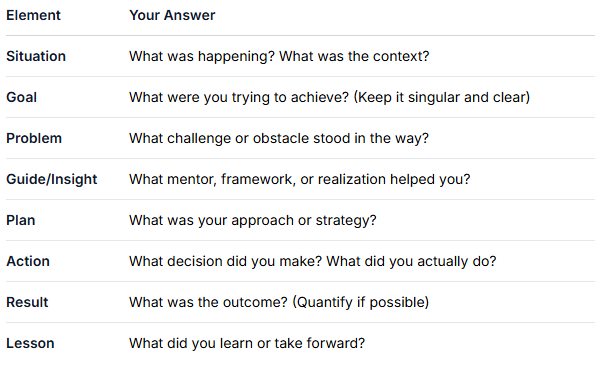
Prompts to Help You Find Your Best Stories
Not sure where to start? Try these:
-
Think of a time you were thrown into something you'd never done before. How did you figure it out?
-
When did you have to make a tough call with incomplete information?
-
What's a project you're genuinely proud of—and why?
-
When did something go wrong, and what did you do about it?
-
What's a time you influenced a decision without having direct authority?
-
When did you help someone else succeed?
Aim for 5-7 stories to start. You'll be surprised how often they overlap with common interview questions.
The Bottom Line
You don't need to be a natural storyteller to tell stories that land. You just need a structure—and a little prep.
So before your next interview, don't just review your resume. Build your Story Stash. Practice saying your stories out loud. And when you walk in, you won't be hoping you sound coherent.
You'll know you do.
☕ Now go refill your coffee and start stashing.
💛 Alyssa



Responses