Hey there,
If you’ve been applying and waiting without much response, it’s easy to start questioning your experience. But a quiet inbox doesn’t automatically mean you aren’t qualified. Sometimes the issue is that one part of your search isn’t making your fit clear, or isn’t creating enough momentum.
This week, let’s look at five places where a job search can lose traction and how to spot what might need attention.
THIS WEEK’S CAREER TIP
A strong job search has more than one moving part
When someone tells me, “I know I can do this work, but I’m not getting interviews,” I don’t immediately assume their résumé needs a rewrite. I want to look at the whole path: what roles they’re pursuing, how they’re presenting their experience, and how they’re getting in front of people.
Think of your search as a series of steps. If one step isn’t working, you can spend a lot of energy on the others without seeing much progress. Here are five places to check:
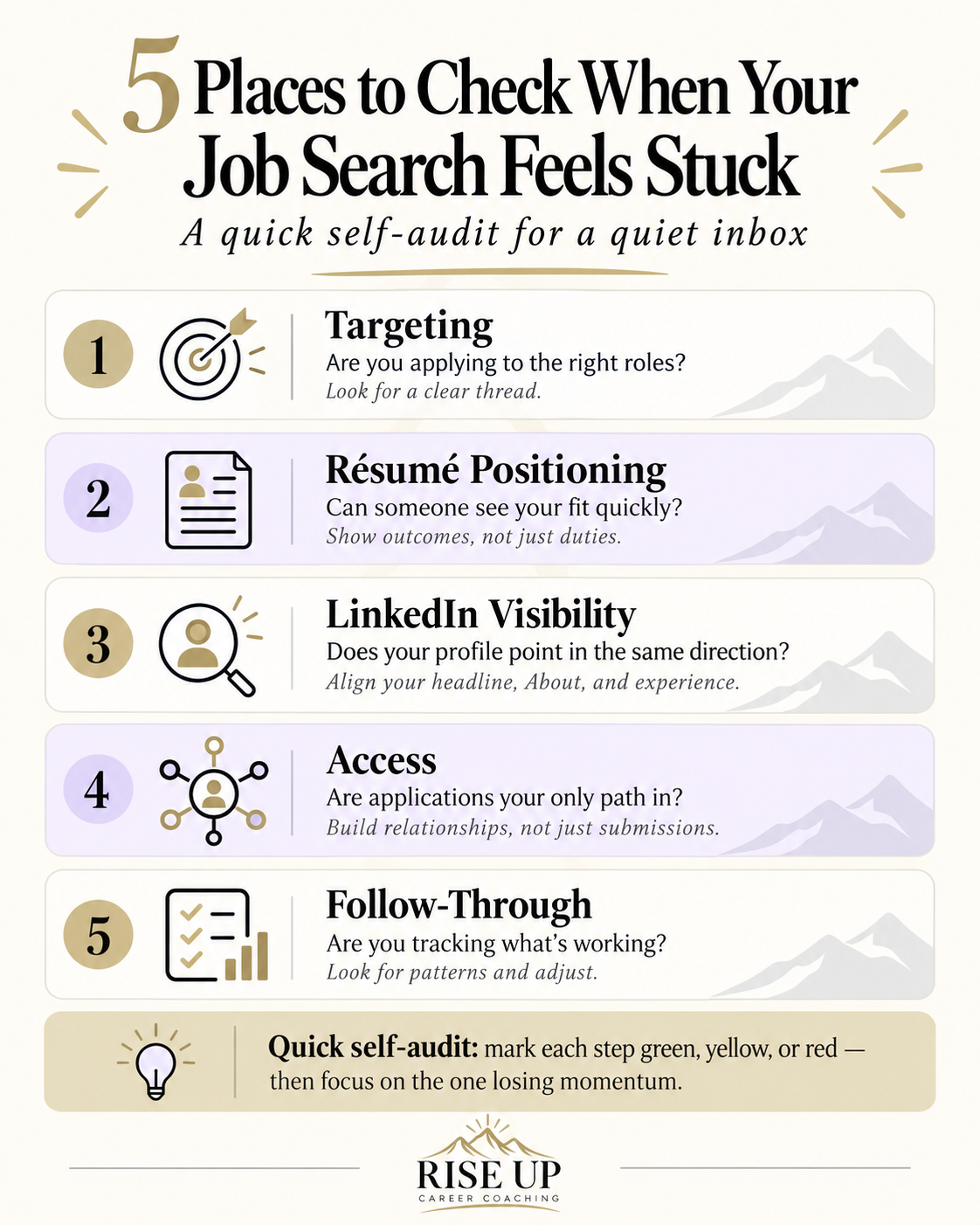
1. Targeting: Are these the right roles for you?
A role can sound appealing and still be a stretch in the wrong direction, or a mismatch for the work and level you want next. If you’re applying to several different kinds of positions, it may be hard to explain what you’re looking for and for an employer to see where you fit.
Look at your last five applications. Do the roles share a clear thread in responsibilities, level, or the problems they need someone to solve? If not, pause before sending more applications and identify what your strongest targets have in common.
2. Résumé positioning: Can someone see your fit quickly?
Your résumé needs to do more than list what you were responsible for. A recruiter or hiring manager should be able to scan it and understand the strengths you’d bring to the role and the results you’ve delivered.
Compare your résumé with one job description you genuinely want. Are the most relevant skills and outcomes easy to find near the top? Do your bullets show what changed because of your work, or mostly describe what you did? If the reader has to connect the dots, make that connection clearer.
3. LinkedIn visibility: Does your profile point in the same direction?
Your LinkedIn profile doesn’t need to repeat your résumé word for word, and you don’t need to post every day. But it should reinforce the same career direction. If your résumé targets one kind of role while your headline or About section points somewhere else, people may be unsure what opportunities to bring your way.
Check your headline, About section, and recent experience. Would someone who lands on your profile understand the kind of work you want to do and the value you offer?
4. Access: Are applications your only path in?
Applying is one way to pursue a role, but it’s not the only way to learn about an opportunity or get your experience in front of the right people. A thoughtful conversation with someone in your network can help you understand a team’s needs, get context about a role, or find out who else you should speak with.
For each role you’re excited about, ask yourself: Do I know anyone connected to this company, team, or field? If not, is there someone I could reach out to for a short, genuine conversation? You’re not asking them to get you hired. You’re building context and relationships around the work you want to do.
5. Follow-through: Are you learning from what happens?
A search can feel like a blur when you’re not tracking what you’ve tried and what response you’re getting. Without that information, it’s hard to tell whether your target roles need refining, your résumé isn’t connecting, or you need to build more relationships.
Keep a simple record of the roles you pursue, how you found them, any conversations you had, and what happened next. Every couple of weeks, look for patterns. Are you getting referrals but no interviews? Applying often but hearing nothing? Having conversations that lead to useful introductions? Each pattern can point you toward a different next step.
The bottom line: A quiet inbox is a reason to review your approach, not proof that your experience has no value.
A CLOSER LOOK
Try a quick self-audit. For each of the five steps, targeting, résumé positioning, LinkedIn visibility, access, and follow-through, give yourself a simple green, yellow, or red. Green means it’s working consistently; yellow means it’s uneven; red means it’s unclear or hasn’t been part of your search.
Then ask: Which step is getting effort but not producing progress? That’s a useful place to focus before you send another batch of applications. You don’t have to overhaul everything at once. Start by identifying the point where your search is losing momentum, then choose one change you can make this week.
Before you go: If you can’t tell where your search is getting stuck, message me “NEXT” and we can talk about what’s happening in your search and what to focus on next.
💛 Alyssa Bailey
Thanks for reading Rise & Shine by Rise Up Career Coaching.
This newsletter is for high-performing professionals who feel stuck, overlooked, or unsure of their next move — and want a clearer, smarter way to navigate the modern job market.
Here, I share real talk about:
-
Getting clear on what you actually want next
-
Navigating job searches without mass applying
-
Networking in ways that actually lead to conversations
-
Interviewing with confidence (even if you’re rusty)
-
Negotiating offers without leaving money or opportunity on the table
The job market has changed, but most career advice hasn’t.
I’m here to help you stop guessing and start moving forward with clarity and strategy.
I'm here to change that.
Get the newsletter delivered straight to you:
📧 Email: Sign up on my website.
💙 LinkedIn: Subscribe here to get it in your feed
ALYSSA BAILEY is a Certified Professional Career Coach who helps high-performing professionals get unstuck and land roles that match who they are now. With 15+ years of corporate experience, she’s guided clients through career transitions, interviews, and negotiations — helping them turn experience into opportunity.
If you’re done waiting for clarity or the “right time,” this is your sign.
Your next role won’t come from working harder.
It comes from having the right strategy.
Let’s make your next move — intentionally.
P.S. If you’ve been thinking about making a change “someday,” remember: clarity doesn’t come from waiting. It comes from action.
Let's make your next move. Contact me today.
To read past Rise & Shine newsletters, you can find them here.

Responses